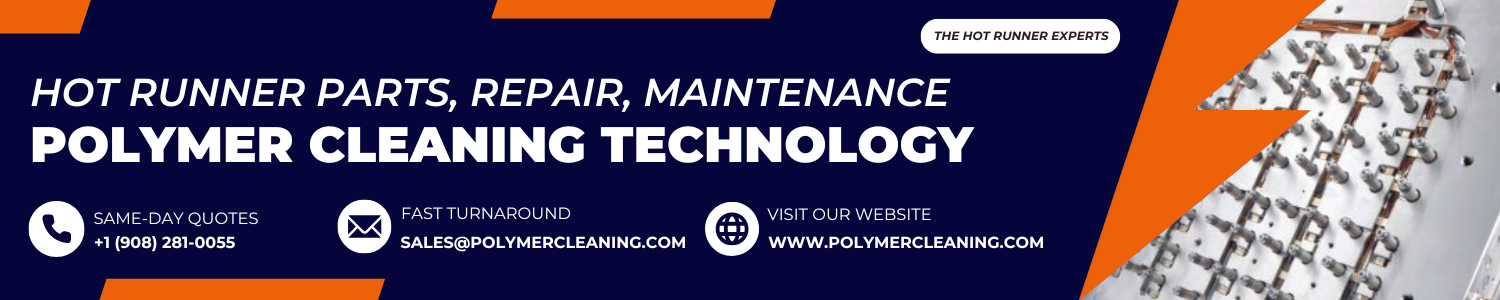
How different nozzle heater styles affect heat transfer, fitment, temperature control, and OEM-compatible replacement selection.
Hot runner heaters are responsible for maintaining the temperatures that keep resin flowing consistently through the nozzle and gate region. When heater design, fitment, or heat transfer characteristics are poorly matched to the application, the result can be unstable processing, uneven thermal behavior, and unnecessary wear on surrounding components. Our current heater category and educational content already position nozzle heaters as core hot runner replacement components, alongside diagnostics, inspections, rebuilds, and replacements for all OEM makes and models.
Different heater styles are used for different nozzle designs, thermal requirements, assembly constraints, and OEM system families. In most hot runner applications, the conversation centers around three core configuration types:

Each style has its own strengths, fitment requirements, and typical use cases. In this guide, we’ll break down how these heater configurations differ, what each is commonly used for, and what buyers should match when sourcing replacement hot runner heaters for systems compatible with major OEM hot runner platforms. As with the rest of our replacement part content, OEM names are used for identification and compatibility purposes only.
Contact +1 (908) 281-0055 or sales@polymercleaning.com to discuss your Hot Runner Systems today! Experts in High Quality Hot Runner Parts, Repair, & Maintenance for all OEM.
Nozzle Heater Styles in Hot Runner Systems
A hot runner heater does more than “make heat.” Its configuration affects how quickly a zone reaches temperature, how evenly heat is distributed, how well the heater fits against the component it serves, and how reliably that zone performs over long production runs. Our recent heater and thermocouple resource emphasizes that heater health directly affects precision, consistency, and long-term reliability, while our broader hot runner temperature-control content ties thermal stability to melt flow, defect reduction, and component life.
A poorly matched or degraded heater can contribute to issues such as:
- temperature instability
- slow response at the nozzle
- localized overheating
- cold spots
- inconsistent gate behavior
- heater lead damage
- premature component wear
That is why heater replacement should be treated as a fitment-and-performance decision, not just an electrical swap.
The Main Variables That Differentiate Nozzle Heater Styles
Before comparing heater styles directly, it helps to understand the variables that matter most.
Contact area
Different heater types transfer heat differently depending on how much of the component surface they contact and how tightly they fit.
Diameter and length
Hot runner heaters are highly dimension-sensitive. A heater that is close but not exact can create poor thermal transfer, assembly problems, or shortened service life.
Watt density and thermal response
Heater design affects how quickly heat is delivered and how concentrated that heat is in a given zone.
Lead orientation and connection style
Lead routing matters in tight hot runner assemblies. Incorrect lead exit location or unsuitable lead protection can create avoidable failure points.
Mechanical form factor
Some applications need a heater that wraps tightly around the nozzle body, while others require a more rigid inserted or clamped heating element.
OEM / system-family compatibility
We manufacture aftermarket replacement hot runner heaters designed for compatibility with a wide range of OEM systems, but exact fitment still depends on the original heater style, dimensions, lead configuration, and surrounding assembly geometry. Our nozzle heater category and product pages consistently frame these parts as OEM-compatible replacements rather than universal components.
Comparison Table
| Heater Configuration | What It Is Commonly Used For | Key Variables to Match | Common Compatibility Context |
|---|---|---|---|
| Coil heater | Tight, high-contact nozzle heating | inner diameter, heated length, wattage, lead exit | Common in many nozzle-focused hot runner assemblies |
| Band heater | Wrapped external heating around a cylindrical surface | inside diameter, width, clamping style, lead location | Used where external wraparound heating is preferred |
| Cartridge heater | Inserted heating in drilled holes or defined bores | diameter, insertion length, wattage, lead protection | Used in certain nozzle, manifold, or tooling-related heating applications |
A Closer Look at Different Nozzle Heater Styles
1. Coil Heaters
Coil heaters are one of the most common hot runner nozzle heater styles. They are designed to wrap closely around the nozzle or heated zone, providing high surface contact and responsive heat transfer.
What they are used for
Coil heaters are commonly used in nozzle heating applications where close conformity to the heated component is important.
Why they are selected
Their flexible wrapped design allows them to maintain close thermal contact around the nozzle body. That makes them a strong fit for applications where compact geometry and responsive heat delivery are important.
What matters most
When matching a replacement coil heater, buyers should verify:
- inside diameter
- heated length
- overall length
- wattage / voltage
- lead exit position
- lead protection style
- nozzle compatibility
A coil heater that is visually similar but dimensionally off can create poor contact, uneven heat transfer, or installation difficulty.
2. Band Heaters
Band heaters are external wraparound heaters that clamp or fit around a cylindrical component.
What they are used for
They are used in applications where a heater needs to surround the outside of a nozzle-related component or similar cylindrical zone with a more defined band-style form.
Why they are selected
Band heaters offer a stable external heating format and can be a good fit where the assembly is designed around a clamped or banded heater footprint rather than a coiled one.
What matters most
Replacement band heaters should be matched by:
- inside diameter
- band width
- heater thickness
- clamping / fastening style
- wattage / voltage
- lead orientation
- application geometry
Improper band fit can reduce thermal transfer and create uneven heating across the zone.
Our site’s heater-related resources and imagery already reflect band-heater relevance within the broader hot runner parts mix, which makes this a natural configuration type to cover in detail.
3. Cartridge Heaters
Cartridge heaters are typically cylindrical inserted heaters designed to fit into a bored hole within a component.
What they are used for
They are commonly used when the assembly is designed around an inserted heater rather than an external wraparound heater. Depending on the system, that can include certain nozzle-related designs, manifold-related heating points, or other tooling-specific thermal zones.
Why they are selected
Because cartridge heaters are inserted into a defined bore, they can provide concentrated heating in a controlled location when the surrounding component is designed for that format.
What matters most
Replacement cartridge heaters should be matched by:
- heater diameter
- insertion length
- wattage / voltage
- fit tolerance
- lead style
- lead exit protection
- surrounding bore geometry
If the heater is undersized, oversized, or poorly matched to the bore, heat transfer and service life can both suffer.
Coil vs Band vs Cartridge: What Changes in Real Use?
Although all three heater styles generate heat, they differ in how they deliver it and how they integrate into the hot runner assembly.
Coil heaters
Best suited to tight-contact wrapped nozzle heating where close conformity matters.
Band heaters
Best suited to external cylindrical heating where the assembly is designed around a banded format.
Cartridge heaters
Best suited to inserted heating applications where the component includes a dedicated bore for the heater.
The correct style is determined by the original system design, not by convenience or visual similarity. That compatibility-first approach is consistent with how we position our aftermarket replacement heaters and broader hot runner parts offering.
OEM Compatibility Contexts
Hot runner heater configurations are often best understood in terms of the system families they are commonly associated with. Our nozzle heater category and product-page language support replacement components compatible with major OEM hot runner systems, while our heater-and-thermocouple support article reinforces that we work across all OEM makes and models.
Depending on the exact design, replacement hot runner heaters may be sourced for compatibility with systems associated with:
- Husky
- Mold-Masters
- MHT
- SACMI
- SIPA
- Yudo
- Milacron
- other major hot runner platforms
Fitment should always be confirmed by heater style, dimensions, wattage, lead configuration, and surrounding assembly requirements, not by OEM family name alone.
How to Match the Right Replacement Nozzle Heater
When sourcing a replacement hot runner heater, the heater style is only the starting point. A proper match usually requires confirming:
- heater configuration type
- inside or outside diameter, depending on style
- heated length
- overall length
- wattage and voltage
- lead length
- lead exit orientation
- protective sleeving or lead armor
- mating component geometry
- OEM reference / compatibility family
Nozzle Heater Material and Build Quality
Not all heater assemblies perform the same over time. Build quality affects durability, thermal consistency, and resistance to failure in demanding molding environments. Our existing Imperium Brass resource also highlights that heater construction material can materially affect efficiency and performance in hot runner applications, which supports treating heater build as part of the selection conversation rather than as an afterthought.
Depending on the application, heater construction can affect:
- heat-transfer efficiency
- durability under repeated thermal cycling
- resistance to lead damage
- response consistency
- service life in demanding environments
Problems Caused by the Wrong Heater Configuration
Using the wrong heater style or a poorly matched replacement can contribute to:
- unstable temperatures
- slow heat-up
- localized overheating
- incomplete heat transfer
- repeated heater failure
- lead breakage or routing issues
- inconsistent molding performance
- recurring maintenance interruptions
Our temperature-control content and heater/thermocouple guidance both reinforce that thermal consistency is central to melt flow stability, defect prevention, and longer component life.
The Difference in Nozzle Heater Styles
Hot runner heater selection is about more than choosing a part that gets hot. Coil, band, and cartridge heaters each serve different assembly designs, heat-transfer needs, and fitment requirements. Understanding those differences helps molders, maintenance teams, and buyers make better replacement decisions and avoid preventable heating problems.
When evaluating replacement hot runner heaters, the best approach is to match the original configuration carefully, verify dimensions and electrical requirements, and confirm compatibility with the exact nozzle or assembly design in use.
Polymer Cleaning Technology: Leading the Way in Hot Runner Services and Parts
With a reputation for precision and reliability, PCT helps manufacturers keep their hot runner systems operating at peak performance.
Services Offered
Hot Runner Cleaning
Specialized chemical-free cleaning systems remove polymer residue without damaging metal surfaces.
Hot Runner Maintenance
Thorough Inspection, Testing, Analysis, Assembly, and Comprehensive Reports.
Preventive Maintenance Programs
Tailored service schedules to suit production environments.
Component Repair & Refurbishment
Includes manifolds, heaters, nozzles, and temperature control systems.
Reverse Engineering & Custom Parts
Solutions for hard-to-find or discontinued OEM parts.
Parts Inventory
- Nozzle Tip Insulators
- Heaters (coils, bands, cartridges)
- Thermocouples
- Nozzle Tips
- Valve Pins
- Nozzle Housings
- Valve Bushings
- Pistons & Spacers
- Seal kits (O-Rings)
Related Reading
- Nozzle Tip Carbonization: How Micro Deposits Create Macro Defects
- Hot Runner Nozzle Maintenance & Troubleshooting Quick Guide
- Hot Runner Nozzles: Selection Guide & Common Problems
*This information is to be used as a general guideline only. Speak to your system manufacturer directly for verified information regarding your Hot Runner System.
*Note: All numerical data and performance examples in this article are drawn from a combination of published supplier datasheets, standard tool-steel references, and aggregated field experience. Where specific case studies are presented, they represent illustrative or typical outcomes, not a controlled laboratory test. Actual results may vary depending on resin chemistry, cycle conditions, and maintenance intervals.
References & Technical Sources
- RJG Inc. Material Degradation, Residence Time, and Gate Behavior
- Plastics Technology Magazine Hot Runner Maintenance & Gate Defect Diagnostics
- Mold-Masters Nozzle Tip Maintenance & Cleaning Guidelines
- Synventive Gate Contamination & Hot Runner Service Documentation
- SPE ANTEC Proceedings Carbon Formation and Polymer Degradation Studies

Find this information useful? Share with friends & colleagues:
Contact Information:
Polymer Cleaning Technology, Inc.
sales@polymercleaning.com
+1 (908) 281-0055
