
5 Causes of Contamination in Hot Runner Systems and How to Prevent Them
Updated October, 2026
Black specks appear halfway through an otherwise stable run. A previous color returns after the changeover seemed complete. One cavity keeps producing streaks while the others look acceptable.
These symptoms call for an investigation, but they do not identify the source by themselves. Contamination can enter with the material, originate in the molding machine, or remain within the hot runner. Cleaning the wrong part of the system can consume time and resin while leaving the problem unresolved.
Hot runner contamination is unwanted material or degraded residue entering or remaining in the melt-delivery system. Five useful investigation areas are incoming material, previous-resin carryover, excessive thermal history, retained deposits, and contamination associated with component condition or maintenance.
This guide explains what to investigate, how to organize the evidence, and when to consider cleaning or repair. For foundational context, see what a hot runner is and how it works.
Ensure Product Quality With a Clean Injection Molding Process
Minimizing contamination in hot runner systems delivers measurable advantages across both production efficiency and product quality. By maintaining clean processing conditions, manufacturers can:
- Ensure Consistent Product Appearance: Avoid blemishes like black specs or streaks that compromise visual quality.
- Reduce Scrap and Rework: Lower the cost of rejected parts by eliminating contamination-related defects.
- Increase Equipment Lifespan: Prevent buildup and degradation that can damage hot runner components.
- Enhance Process Stability: Maintain tighter control over molding conditions and material behavior.
- Optimize Production Time: Reduce downtime caused by maintenance, troubleshooting, or mold cleaning.
Effective injection molding contamination control ultimately supports higher yields, lower operational costs, and more reliable delivery of high-performance plastic parts.

Contact +1 (908) 281-0055 or sales@polymercleaning.com to discuss your Hot Runner Systems today! Experts in Hot Runner Cleaning, and Maintenance for all OEM.
First, identify the defect
Black specks, burn marks, and splay are different observations. Mold-Masters lists machine contamination, raw-material contamination, and runner dead spots among possible sources of dark specks. Its troubleshooting guide separately addresses burns associated with trapped gas and defects related to moisture. [1]
Describe the defect before naming the cause. Record its color, shape, location, frequency, and whether it is embedded in the part or on its surface. Preserve labeled samples and photographs; “dirty parts” is too vague to guide service work.
| Observation | Investigation question | What it does not establish |
|---|---|---|
| Dark particles in the part | Is foreign material or degraded residue entering the melt? | That every particle is carbon or came from the manifold |
| Previous color reappears | Where could earlier material remain? | That the hot runner is the only source |
| Localized burn near the end of fill | Is trapped gas or cavity venting involved? | That deposits are circulating through the manifold |
| Silver streaks or splay | Have moisture, gas, and material preparation been evaluated? | That internal cleaning will correct the defect |
| Defect begins after maintenance | What changed in the assembly or setup? | That the new component is necessarily defective |
These questions are starting points. Compare the pattern with production history, material records, and physical findings.
Five causes of hot runner contamination
1. Contaminated incoming resin, additives, or regrind
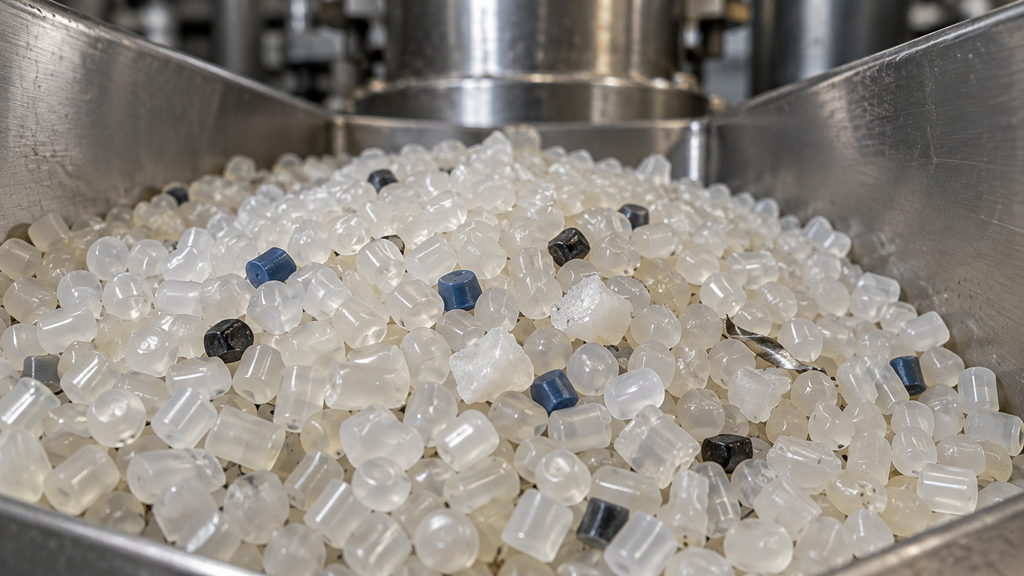
Start at the material supply. Check resin identification, colorant identification, containers, transfer equipment, and the regrind stream before opening the mold.
As an example of material-specific guidance, Celanese identifies contamination risks during Celcon acetal handling and addresses metallic contamination and regrind control. [2] Apply the requirements for the actual grade rather than transferring one material’s instructions to every job.
Build traceability into the investigation:
- Record resin, colorant, and regrind lot information.
- Identify the dryer, loader, hopper, and conveying route supplying the job.
- Retain a representative feed sample under the plant’s quality procedure.
- Compare the start of the defect with replenishment or a lot change.
- Review how containers and shared handling equipment were cleared between jobs.
If an authorized material trial is appropriate, document what changed and keep the other approved conditions consistent. Replacing several inputs at once may restore production while leaving the source unknown.
2. Previous resin or color left behind during changeover
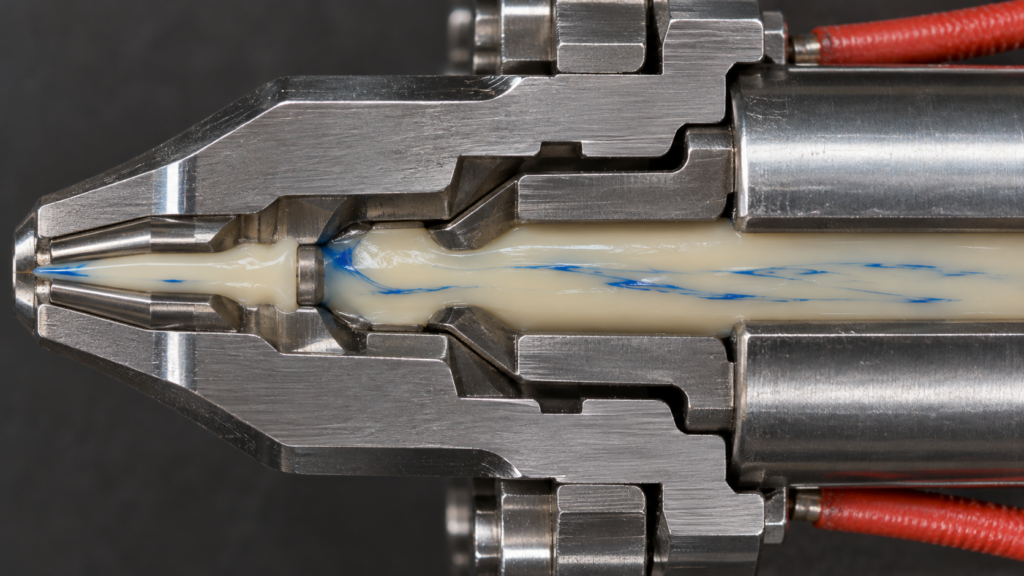
A color transition involves more than changing the material at the hopper. Earlier material can remain in the flow path and reappear after the new color initially looks acceptable.
Husky explains that old color can persist in stagnant regions and that residence volume, nozzle/gate geometry, and thermal conditions affect displacement. The machine-nozzle/hot-runner interface also deserves attention. [3]
Document the outgoing and incoming grades, colorants, approved transition method, purge product if used, and acceptance criteria. Keep separate records for the machine barrel and hot runner so that “purged” has a clear meaning.
Compatibility needs its own check. Celanese warns that Celcon acetal and PVC must not mix in the melt, including trace contamination. [2] A visually acceptable color transition is therefore not a universal compatibility test.
Use a transition procedure approved for the specific material pair and equipment. When the previous material is unknown, resolve that uncertainty before selecting a purge sequence.
3. Excessive heat history during processing or interruptions
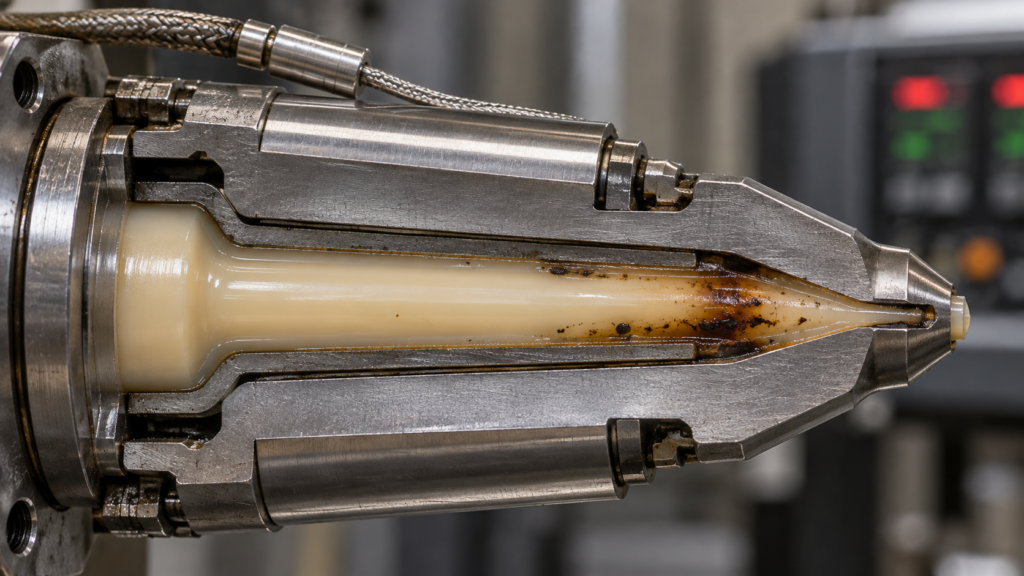
Material can degrade before it reaches the cavities. Asaclean identifies overheating, extended barrel residence, and excessive shear associated with processing conditions as contributors to black-speck contamination. Additives and color concentrates can also be involved. [4]
Review the complete run history rather than only the readings at the moment the defect appeared. Useful records include interruption duration, recipe changes, alarms, cycle changes, and the material remaining in each part of the system.
Ask the process team:
- Did contamination begin after an interruption or restart?
- Did the resin, color package, cycle, or shot requirement change?
- Were temporary settings left in place?
- Does the setup match the approved process revision?
- Is there a documented response when a short interruption becomes a long stop?
Use the resin supplier’s limits and equipment-specific procedure to decide the response. There is no universal standby temperature or safe holding time for every resin and system.
A useful prevention measure is a clear handoff record: what stopped the run, how long it stopped, what material remains inside, and what the next operator must verify.
4. Retained deposits and material in poorly flushed areas
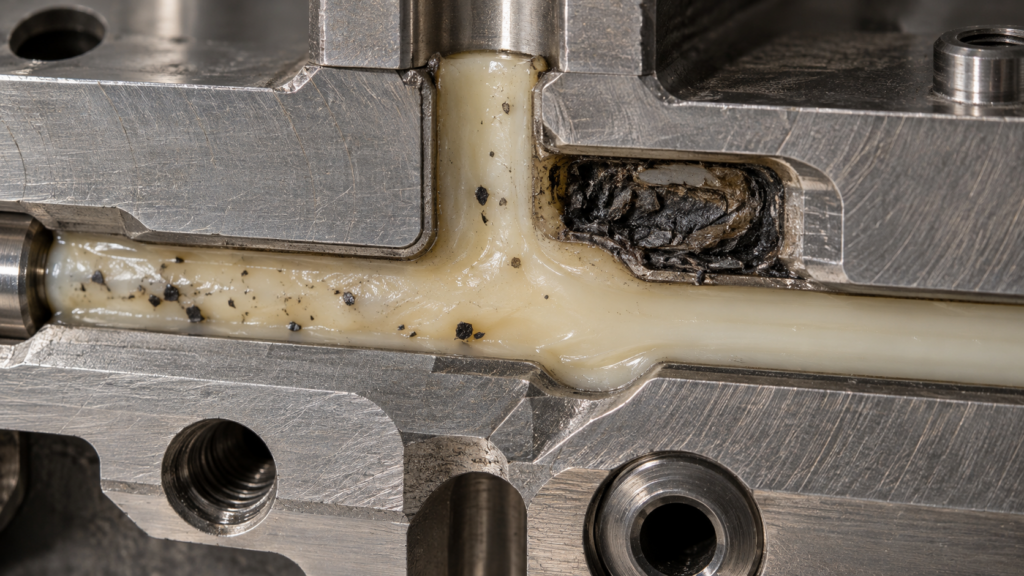
Some contamination is intermittent because old material remains in areas that are difficult to displace. Asaclean describes retained material and deposits releasing into production, causing recurring specks or streaks. [5]
Removing today’s visible contamination and correcting the condition that allows it to return are separate goals. A short successful run does not explain a repeated failure after every changeover or restart.
Assemble a history of affected cavities, material transitions, cleaning attempts, and elapsed production before recurrence. Ask the service provider to document the received condition before removing residue.
Husky’s discussion of melt-channel geometry and thermal variation shows why investigation may involve component interfaces and design as well as cleaning. [3] Avoid prescribing channel polishing, coatings, or geometry changes without engineering review.
PCT’s hot runner manifold cleaning guide explains cleaning approaches and accompanying inspections in more detail.
5. Foreign material associated with component condition or maintenance
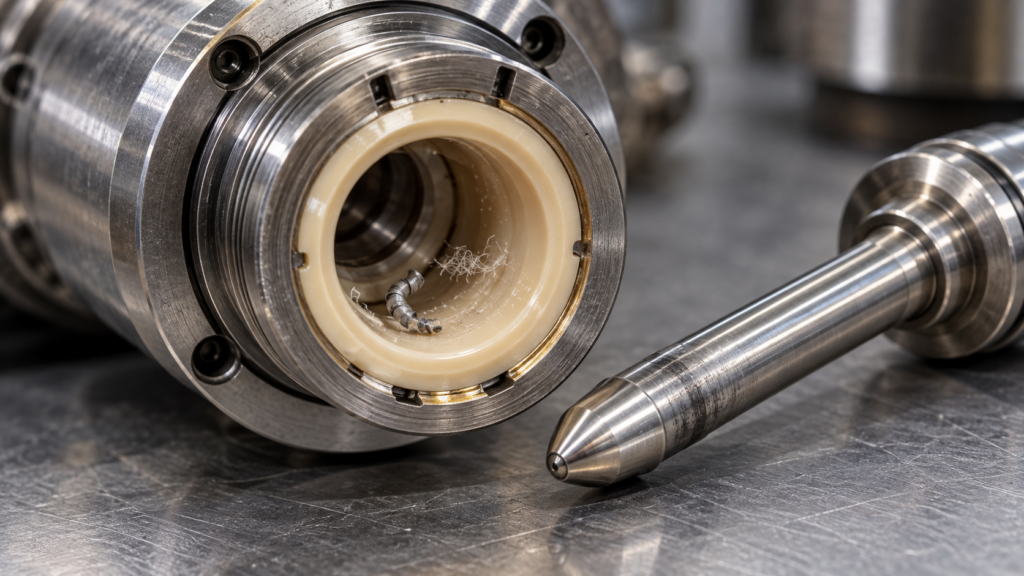
When a defect starts after service, make the work record part of the investigation. Ask what was removed, cleaned, repaired, replaced, lubricated, or reassembled, and what checks were completed before release.
Possible findings need a credible route into the part. Dirt outside the hot half, a damaged seal, or a worn component does not automatically establish contamination of the internal melt stream.
Ask the technician to identify:
- Where the suspected material was found.
- Whether it could contact resin or transfer directly to the molded part.
- Which surfaces show relevant damage or residue.
- What evidence connects the finding to the reported defect.
- Whether cleaning, repair, or replacement is required.
If an inclusion cannot be identified visually, preserve it for qualified analysis instead of labeling it “metal,” “carbon,” or “seal debris” from appearance alone. Use PCT’s hot runner parts guide to keep component names consistent in the service request.
How to narrow down the contamination source
The following is a suggested investigation record, not a machine-operating or disassembly procedure. Inspection and sampling must follow the plant’s approved safety and quality procedures.
Step 1: Contain the quality issue and save evidence
Identify affected production under the quality plan. Save samples with cavity identification, time, resin lot, and machine/mold identification. Note whether the defect occurs at startup, after replenishment, after a changeover, or during steady production.
Step 2: Compare where and when defects appear
Create a cavity-by-time record. A shared pattern gives the team a different investigation path from a recurring defect at one location. This is a diagnostic inference, not proof: a common upstream source can appear unevenly, and a local symptom can have multiple causes.
Step 3: Check upstream evidence separately
Review feed-material findings and barrel-purge observations collected under the approved procedure. A barrel sample represents that sample and location; it does not certify the hot runner downstream.
State the limits of the observation. “No visible specks in this sample” is more accurate than “the machine is clean.”
Step 4: Test one justified change at a time
Write down the hypothesis, authorized action, and expected result before a trial. For example: “The symptom began with a new material lot; compare a verified supply under an approved trial.” Record both improvement and non-improvement.
Step 5: Define when to escalate
Agree on conditions that end a trial and trigger service review. These may include recurrence after the approved cleaning attempt, an unresolved equipment fault, suspected damage, or inability to establish the material history.
This keeps troubleshooting from becoming an open-ended series of purge attempts.
Purging, cleaning, or repair: choosing the next action
| Finding | Suggested next decision |
|---|---|
| Traceable incoming-material problem | Correct or contain the supply issue and determine downstream recovery needs |
| Known, compatible changeover residue | Evaluate the approved transition or hot-runner purging procedure |
| Recurrence after that procedure | Review whether internal inspection and cleaning are warranted |
| Documented mechanical or electrical fault | Address the fault and evaluate contamination separately |
| Burn or splay diagnosis without evidence of deposits | Follow the relevant molding/material troubleshooting path |
| Unknown inclusion | Preserve samples and obtain qualified analysis |
Confirm purge compatibility before use
A compound suitable for a screw and barrel is not automatically suitable for the hot runner. Asaclean’s instructions require a hot-runner-approved grade matched to minimum clearances and temperature range; internally heated systems require additional technical consultation. [6]
Confirm the exact product, resin compatibility, equipment limitations, gate clearances, and supplier procedure. Do not adopt a blanket instruction to use glass-filled or abrasive purge, raise temperature, or increase pressure. Adjustments must remain within the applicable approved limits.
Include inspection when contamination keeps returning
A cleaning request should explain the symptom and history, not simply ask for a “clean hot half.” Request findings that help determine why the problem occurred and what needs to change before return to production.
PCT provides hot runner cleaning, inspection, repair, and refurbishment services. Discuss the scope for the specific system and request documentation of conditions requiring further action.
Prevent recurrence with a documented control plan
Assign each recurring problem a corrective action, an owner, and a verification method.
| Control | Record to maintain |
|---|---|
| Material identification | Resin, colorant, and permitted regrind details |
| Changeover | Previous material, next material, procedure, release result |
| Interruptions | Times, response, and material left in the equipment |
| Maintenance | Components serviced, findings, replacements, release checks |
| Quality verification | Cavity samples and acceptance results |
| Recurrence review | Defect frequency, scrap, purge usage, and downtime for comparable jobs |
Choose inspection and cleaning intervals from system requirements and operating history. Avoid assuming that a fixed interval or one purge product will prevent every event.
After corrective work, verify performance through the release plan and appropriate follow-up production. Record what was confirmed and what remains uncertain.
FAQ: Hot Runner Contamination
Do black specks always mean the hot runner needs cleaning?
No. Include feed material and the molding machine in the investigation. Preserve samples and identify supporting evidence before deciding where to intervene.
Can venting problems look like contamination?
They can produce discoloration that is mistaken for contamination. A localized burn associated with trapped gas requires a different investigation from particles carried through the melt. [1]
Why can contamination return after purging?
The source may remain unresolved, or the cleaning attempt may not have addressed retained material. Compare recurrence with the original symptom before repeating the same intervention.
How many purge cycles prove that a system is clean?
There is no universal release count. Establish acceptance for the specific resin, system, and part requirements and document the results.
What information should I send PCT?
Send system identification, resin and color details, affected cavities, photographs, interruption history, and previous corrective attempts. Include relevant drawings and service history when available.
Discuss recurring contamination with PCT
If black specks, color carryover, or unexplained inclusions continue after investigation and approved corrective steps, contact Polymer Cleaning Technology to discuss inspection, cleaning, or repair.
Call +1 (908) 281-0055 or email sales@polymercleaning.com. Describe when the problem occurs, where it appears, and what has already been tried so PCT can discuss an appropriate service scope.
*This article provides general troubleshooting guidance. Operation, purging, isolation, and maintenance must follow applicable equipment manuals, material instructions, and approved plant procedures.
Polymer Cleaning Technology: Leading the Way in Hot Runner Services and Parts
With a reputation for precision and reliability, PCT helps manufacturers keep their hot runner systems operating at peak performance.
Services Offered
Hot Runner Cleaning
Specialized chemical-free cleaning systems remove polymer residue without damaging metal surfaces.
Hot Runner Maintenance
Thorough Inspection, Testing, Analysis, Assembly, and Comprehensive Reports.
Preventive Maintenance Programs
Tailored service schedules to suit production environments.
Component Repair & Refurbishment
Includes manifolds, heaters, nozzles, and temperature control systems.
Reverse Engineering & Custom Parts
Solutions for hard-to-find or discontinued OEM parts.
Parts Inventory
- Nozzle Tip Insulators
- Heaters (coils, bands, cartridges)
- Thermocouples
- Nozzle Tips
- Valve Pins
- Nozzle Housings
- Valve Bushings
- Pistons & Spacers
- Seal kits (O-Rings)
*This information is to be used as a general guideline only. Speak to your system manufacturer directly for verified information regarding your Hot Runner System.
Technical Sources
- Mold-Masters: Hot Runner Troubleshooting Guide: dark specks, burn marks, and moisture-related defects.
- Celanese: Celcon Processing and Troubleshooting Guide: handling, regrind, and incompatibility. Consult current grade-specific instructions for operation.
- Husky: Improved Color Change Performance with Optimized Hot Runner Systems: retained color, geometry, interfaces, and thermal profile.
- Asaclean: Carbon Contamination: degradation contributors.
- Asaclean: Hot Runner Contamination—Why It Happens and How to Clean It: retained material and intermittent contamination.
- Asaclean: Hot Runner Purging Instructions: product suitability and equipment restrictions. The operating instructions are method-specific.

Find this information useful? Share with friends & colleagues:
Contact Information:
Polymer Cleaning Technology, Inc.
sales@polymercleaning.com
+1 (908) 281-0055
