Understanding Every Component That Keeps Your Production Lines Running
A hot runner system is only as reliable as the parts that make it up. While the system itself is often discussed as a whole, real-world performance comes down to the individual components working together under heat, pressure, and time. When one part begins to fail – whether it’s a heater, thermocouple, or nozzle tip – the entire system can quickly follow.
This complete hot runner parts guide breaks down major hot runner components; What it actually does in operation, How it impacts performance & part quality, and Where failures may commonly occur.
Contact +1 (908) 281-0055 or sales@polymercleaning.com to discuss your Hot Runner Systems today! Experts in High Quality Hot Runner Parts, Repair, & Maintenance for all OEM.
The Anatomy of a Hot Runner System
At a high level, hot runner systems are built from three functional groups:
Quick System Breakdown
| Function | Components |
|---|---|
| Thermal Control | Heaters, Thermocouples, Insulation |
| Melt Delivery | Manifold, Nozzles, Tips |
| Mechanical & Sealing | Valve Pins, Bushings, Seals, Spacers |
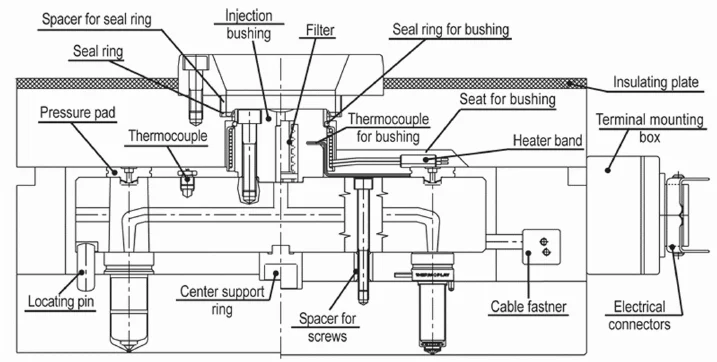
Each group plays a role in maintaining:
- temperature consistency
- flow balance
- system integrity
Hot Runner Components FAQ
What are the main parts of a hot runner system?
The main parts include nozzle tips, nozzles, heaters, thermocouples, manifolds, valve pins, bushings, pistons, spacers, insulators, and seals.
Which hot runner components fail most often?
Heaters, thermocouples, seals (O-rings), and nozzle tips are among the most commonly replaced components due to wear, heat exposure, and material buildup.
How do I know when a hot runner part needs replacement?
Signs include inconsistent filling, leakage, temperature instability, visible wear, or defects in molded parts. Always consult your system’s OEM guides.
Are aftermarket hot runner parts reliable?
High-quality aftermarket parts designed for compatibility with OEM systems can provide reliable performance and cost-effective alternatives.
What causes hot runner component wear?
Wear is typically caused by high temperatures, mechanical stress, abrasive materials, and prolonged use without maintenance.
What happens if a hot runner heater fails?
A failed heater can create a cold zone, causing material to solidify and block flow, leading to short shots or production downtime.
How often should hot runner parts be replaced?
Replacement frequency depends on usage, materials, and maintenance, but critical components should be regularly inspected and replaced as needed.
The Core Hot Runner Components
Hot Runner Manifold
The Distribution Core of the System
The hot runner manifold is responsible for evenly distributing molten plastic from the injection unit to each nozzle. While often viewed as a passive component, it is one of the most critical determinants of system performance.
Internally, the manifold contains precision-machined melt channels, typically drilled and plugged, that must be engineered to maintain:
- equal flow path lengths
- consistent pressure drop
- uniform temperature distribution
What It Actually Controls
- melt balance between cavities
- residence time of material
- pressure distribution across the mold
Engineering Considerations
| Factor | Impact |
|---|---|
| Channel Diameter | Controls pressure and shear |
| Surface Finish | Affects flow resistance |
| Channel Geometry | Prevents dead spots |
| Material (H13, 420 SS) | Impacts thermal fatigue resistance |
Real-World Insight
Even slight imbalances in manifold design can cause:
- short shots in certain cavities
- overpacking in others
- inconsistent part weights
👉 Read “Hot Runner Manifolds Explained”
Nozzles
The Controlled Transition from Manifold to Mold
Hot runner nozzles transfer molten plastic from the manifold into the mold cavity while maintaining thermal and flow consistency.
They operate in one of the most sensitive zones of the system – where:
- temperature gradients are highest
- flow restrictions are tightest
- part quality is determined
Types of Nozzles
| Type | Function |
|---|---|
| Open (Thermal Gate) | Constant melt flow |
| Valve Gate | Mechanically controlled flow |
What Nozzles Control
- gate formation
- shear rate at entry point
- freeze-off behavior
- cosmetic finish of the part
Common Failure Modes
- drooling (too hot or poor sealing)
- stringing (improper shutoff)
- gate blush or vestige
Pro Insight
Nozzles must balance heat retention and heat dissipation simultaneously – too much of either creates instability.
Nozzle Tips
The Final Interface Between Melt and Mold
Nozzle tips are the last point of contact before molten plastic enters the cavity, making them one of the most influential components for part quality and consistency.
What They Control
- gate size and geometry
- material flow pattern
- shear rate entering the cavity
Tip Design Variations
| Type | Application |
|---|---|
| General Purpose | Standard molding |
| High Flow | Thin-wall applications |
| Abrasion Resistant | Glass-filled materials |
| Shut-Off Tips | Reduce drool/stringing |
Why Tip Selection Matters
Incorrect tip selection can cause:
- excessive shear → material degradation
- poor flow → short shots
- cosmetic defects → visible gate marks
Wear & Maintenance Insight
Tips are high-wear components due to:
- constant material flow
- high shear forces
- abrasive fillers
Nozzle Housings
Structural Integrity + Thermal Management
Nozzle housings act as the structural body of the nozzle assembly, supporting internal components while maintaining controlled thermal conditions.
What They Do
- house heaters and thermocouples
- maintain alignment with the manifold
- protect internal flow paths
Engineering Considerations
| Factor | Impact |
|---|---|
| Material | Heat transfer + durability |
| Fitment | Prevents leakage |
| Thermal Expansion | Must match system behavior |
Real-World Insight
Misalignment or distortion in nozzle housings often leads to:
- uneven heating
- leakage at interfaces
- premature component wear
Heaters
The Thermal Backbone of the System
Heaters provide the energy required to keep plastic in a molten, processable state throughout the system.
Heater Types & Roles
| Type | Location | Role |
|---|---|---|
| Cartridge Heaters | Manifold | Maintain bulk temperature |
| Coil Heaters | Nozzles | Precision heating |
| Band Heaters | Larger zones | Supplemental heat |
What Heaters Actually Influence
- melt viscosity
- flow consistency
- startup stability
- energy efficiency
Failure Behavior
Heaters rarely fail completely – instead they:
- degrade unevenly
- create hot/cold zones
- cause inconsistent processing
Pro Insight
A system can appear “fully operational” electrically while being thermally unstable.
Thermocouples
Temperature Control Starts Here
Thermocouples provide the feedback required to regulate heating zones, making them essential to system stability.
What They Actually Measure
- steel temperature (NOT melt temperature)
Why This Matters
Controllers rely on thermocouples to:
- adjust heater output
- maintain setpoints
- detect abnormalities
Common Issues
- drift over time
- delayed response
- incorrect placement
Failure Impact
A faulty thermocouple can cause:
- overheating → material degradation
- underheating → flow restrictions
Thermocouples are small, but they control everything downstream
Valve Pins
Precision Mechanical Flow Control
Valve pins physically open and close the gate, allowing for precise control over material flow.
What They Enable
- clean gate shutoff
- sequential injection
- reduced cosmetic defects
Key Performance Factors
| Factor | Impact |
|---|---|
| Tip Geometry | Gate quality |
| Coating | Wear resistance |
| Alignment | Sealing performance |
Wear Patterns
- tip erosion
- coating breakdown
- bending or misalignment
Real Insight
Valve pin issues often show up as:
- flashing
- inconsistent fill
- timing problems
Valve Pin Bushings
Guiding Motion Under Heat and Pressure
Bushings guide the valve pin and maintain alignment during operation.
Why They Matter
- prevent metal-on-metal wear
- ensure smooth movement
- maintain gate precision
Failure Indicators
- increased friction
- inconsistent pin movement
- premature pin wear
Insulators (Nozzle Tip Insulators)
Controlling Heat Where It Matters Most
Insulators are used to separate hot and cold zones, ensuring that heat stays where it is needed.
Common Materials
- Vespel SP1 (high-performance polymer)
- Ceramic-based materials
What They Prevent
- heat loss into mold plates
- unstable temperature zones
- excessive energy consumption
Real-World Impact
Without proper insulation:
- operators compensate by increasing temperature
- material degradation increases
- system efficiency drops
Seals (O-Rings & Seal Rings)
Maintaining Pressure Integrity
Seals prevent molten plastic from escaping under high pressure.
What They Handle
- high temperatures
- repeated thermal cycles
- injection pressure
Failure Signs
- leakage
- burn marks
- carbon buildup
Critical Insight
Seal failure is often a symptom, not the root cause – usually tied to:
- misalignment
- thermal expansion
- worn components
👉 View PCT Seal Kits (O-Rings)
Spacers & Support Components
Managing Thermal Expansion and Alignment
Spacers and supports maintain the physical structure of the system while allowing controlled expansion.
Why They Matter
- prevent distortion
- maintain component spacing
- reduce stress on interfaces
Engineering Reality
Hot runner systems expand significantly under heat – without proper spacing:
- long-term damage occurs
- components shift
- sealing surfaces fail
How These Parts Work Together
Each piece has a specific job, but hot runner systems are not independent hot runner components – they are interdependent systems, after all.
System Interaction Table
| If This Fails | It Affects |
|---|---|
| Heater | Melt viscosity, flow balance |
| Thermocouple | Temperature control accuracy |
| Nozzle Tip | Gate quality, flow pattern |
| Valve Pin | Shot consistency |
| Insulation | Energy efficiency, stability |
Most problems are multi-component failures, not single-part issues.
A hot runner system works best when heat, flow, pressure, alignment, and shutoff are all controlled together. One component may create the original problem, but the visible symptom often appears somewhere else in the system. This is why a short shot, leaking gate, cosmetic defect, or unstable temperature zone should not be diagnosed by looking at only the most obvious part.
For example, a nozzle tip may show wear at the gate, but the root cause could involve poor heater contact, thermocouple drift, misalignment in the nozzle housing, improper insulation, or a valve pin that is not shutting off cleanly. In the same way, a heater may be blamed for temperature instability when the actual issue is a loose thermocouple, poor thermal contact, damaged wiring, or heat loss caused by worn insulation.
That relationship is what makes hot runner troubleshooting so important. Replacing the visible failed part may get the system running again temporarily, but if the surrounding cause is not corrected, the same issue can return during the next production run.
Thermal Control Drives Melt Behavior
The heater, thermocouple, insulation, nozzle housing, and manifold all work together to control how resin behaves inside the hot runner system. Resin viscosity changes with temperature, so even a small thermal imbalance can affect fill pressure, gate quality, cycle consistency, and part appearance.
If a heater begins to weaken, the zone may recover slowly or develop cold spots. If a thermocouple reads inaccurately, the controller may apply too much or too little heat. If insulation is damaged or compressed, heat can escape into the mold or surrounding steel instead of staying concentrated where it is needed.
When these problems overlap, operators may see symptoms such as:
- Short shots or incomplete fill
- Stringing or drooling at the gate
- Burn marks or material degradation
- Inconsistent part weight
- Gate blush or poor cosmetic finish
- Startup instability
- Temperature zones that seem difficult to control
In many cases, the issue is not simply that the resin is “too hot” or “too cold.” The more important question is whether the system is applying, measuring, and retaining heat consistently across the correct locations.
Flow Balance Dependency
The manifold distributes molten plastic to each nozzle, but flow balance depends on the full melt path. Heater output, nozzle tip condition, gate geometry, resin behavior, and valve pin timing can all influence whether cavities fill evenly.
A balanced manifold can still produce inconsistent parts if one nozzle tip is worn, one heater is underperforming, one thermocouple is drifting, or one valve pin is closing differently than the others. This is why cavity-to-cavity variation often requires a broader inspection than the manifold alone.
When fill imbalance appears, the inspection path should usually include:
- Manifold flow paths
- Nozzle tips
- Nozzle heaters
- Thermocouples
- Valve pins
- Pistons and actuation components
- Gate condition
- Material contamination or degradation
The key is to evaluate the system as a complete melt delivery path, not just as a collection of separate replacement parts.
Shutoff Quality Depends on Alignment and Actuation
In valve-gated systems, the valve pin controls gate opening and shutoff. However, the valve pin does not work alone. It relies on proper guidance, alignment, piston movement, actuation pressure, and gate condition.
A worn valve pin can cause drooling, flashing, poor vestige, or inconsistent shutoff. But similar symptoms can also come from a worn valve bushing, damaged piston seal, misaligned nozzle housing, contaminated gate area, or inconsistent actuation timing.
That is why repeated valve pin replacement without inspecting the surrounding components can lead to the same problem returning. If the pin is being forced out of alignment, sticking during travel, or closing against a damaged gate, the new pin may wear prematurely.
For valve-gated systems, the valve pin, valve bushing, piston, seals, spacer stack, and gate area should be evaluated together.
Sealing and Alignment Protect the Entire System
Seals, O-rings, spacers, housings, and support components help keep the hot runner system aligned and contained under heat and pressure. These parts may seem secondary compared with heaters, thermocouples, and nozzle tips, but they often determine whether the system stays stable during production.
A worn seal may show up as plastic leakage, but the cause may be excessive thermal expansion, poor seating, damaged steel, incorrect stack height, or misalignment between the manifold and nozzle. A worn spacer may not create an obvious defect by itself, but it can change component positioning enough to affect tip contact, valve pin alignment, or sealing pressure.
These support components matter because hot runner systems operate under repeated cycles of heat, pressure, expansion, and movement. Small fitment issues can become larger production problems once the system is running at temperature.
Why the Visible Symptom Is Not Always the Root Cause
One of the most common troubleshooting mistakes is assuming that the part closest to the defect is automatically the part that caused the defect.
If there is drooling at the gate, the nozzle tip may be involved — but so may heater control, valve pin shutoff, resin temperature, gate wear, or actuation timing.
If a zone shows temperature instability, the heater may be involved — but so may the thermocouple, wiring, controller, insulation, or contact between the heater and nozzle body.
If leakage appears near the manifold or nozzle, the seal may be involved — but so may thermal expansion, alignment, spacer condition, housing wear, or excessive pressure.
A more accurate approach is to start with the symptom, then identify which parts influence that symptom.
Practical Troubleshooting Example
A processor notices stringing and occasional drooling at one gate. The first assumption may be that the nozzle tip is worn. That may be correct, but a complete inspection would also ask:
- Is the heater maintaining stable temperature in that zone?
- Is the thermocouple reading accurately?
- Is the nozzle tip damaged, worn, or incorrectly seated?
- Is the valve pin closing fully and consistently?
- Is the piston or actuation system moving the pin correctly?
- Is the gate area worn or contaminated?
- Is the insulation allowing excess heat loss or heat transfer?
This kind of inspection helps prevent unnecessary part replacement. It also helps avoid replacing one component while leaving the actual cause untouched.
System-Level Thinking Reduces Repeat Failures
The best maintenance programs look for patterns, not just broken parts. If the same heater position fails repeatedly, there may be an issue with fit, wiring, contamination, installation, or heat transfer. If the same gate keeps showing cosmetic defects, the issue may involve tip wear, valve pin alignment, gate condition, or thermal control. If leakage returns after new seals are installed, the surrounding alignment and seating surfaces should be checked.
Looking at the system this way helps reduce repeat failures, unexpected downtime, scrap, and emergency part replacement.
For a guided starting point, PCT’s Hot Runner Troubleshooting Assistant can help connect common production symptoms with the hot runner components most likely to require inspection. After the likely inspection areas are identified, PCT can help evaluate whether cleaning, maintenance, repair, refurbishment, reverse engineering, or replacement parts are the best next step.
Common Hot Runner Part Failures
Hot runner problems are rarely isolated to one part. A cosmetic defect, short shot, leaking gate, temperature swing, or startup issue may begin with one failed component, but the symptoms often involve several related parts working together. A worn nozzle tip may affect gate quality, but the underlying issue could also involve heater output, thermocouple feedback, valve pin alignment, seal wear, or piston actuation.
That is why troubleshooting hot runner components should begin with the production symptom, then move into a focused inspection of the parts most likely to influence that issue.
For symptom-based guidance, use PCT’s new Hot Runner Troubleshooting Assistant to narrow down which inspection areas may deserve attention before replacing parts or scheduling service.
1. Heater Degradation
Heaters provide the thermal energy needed to keep resin at a consistent processing temperature as it travels through the manifold and nozzle assembly. Over time, cartridge heaters, coil heaters, and band heaters can degrade from repeated thermal cycling, contamination, wiring fatigue, or poor heat transfer against the surrounding steel.
A failing heater may not stop working immediately. In many cases, it creates uneven heating first. This can lead to cold spots, slow recovery after startup, inconsistent melt viscosity, short shots, stringing, drooling, or poor gate appearance.
Common signs of heater-related issues include:
- Slower startup or longer recovery time
- Temperature zones struggling to reach setpoint
- Unstable temperature control
- Inconsistent part weight or fill
- Material degradation from nearby overheated zones
- Cold slugging or flow hesitation near the gate
When heater problems appear, inspect the heater fit, wiring, resistance values, controller feedback, and nearby thermocouple condition before assuming the heater alone is the only failed part.
👉 Replacement Nozzle Heaters for All OEM
2. Thermocouple Drift or Poor Feedback
Thermocouples are responsible for providing the temperature feedback used by the controller to regulate each zone. A thermocouple does not directly measure melt temperature. It measures the temperature at its installed location in the steel. If that reading is inaccurate, delayed, loose, or poorly positioned, the controller may overheat or underheat the zone without the operator realizing it.
Thermocouple drift can create confusing symptoms because the controller may show a normal reading while the actual zone behavior is unstable. This can lead to resin degradation, flow restriction, inconsistent cycling, or unnecessary heater replacement.
Common signs of thermocouple-related issues include:
- Temperature readings that appear stable but process behavior is not
- Zones overshooting or undershooting during startup
- Unexplained material burning or discoloration
- Inconsistent gate freeze-off
- Frequent controller alarms
- A heater being blamed repeatedly for the same zone issue
Thermocouple problems should be evaluated alongside heater condition, wiring, controller performance, and the physical fit of the component inside the nozzle or manifold.
👉 Replacement Thermocouples for All OEM
3. Nozzle Tip Wear or Damage
Nozzle tips control the final melt path before resin enters the gate area. Because they sit at a critical transition point between the hot runner and the mold cavity, even minor tip wear can affect gate quality, flow behavior, and cosmetic results.
Nozzle tips may wear from abrasive or filled resins, repeated thermal cycling, improper installation, misalignment, or excessive mechanical contact at the gate. A damaged or incorrectly fitted tip can create stringing, drooling, short shots, gate blush, flow imbalance, or inconsistent vestige.
Common signs of nozzle tip issues include:
- Drooling or stringing at the gate
- Short shots or incomplete fill
- Gate blush, burn marks, or poor cosmetic finish
- Inconsistent vestige size
- Material hang-up or contamination
- Uneven flow from cavity to cavity
Before replacing a nozzle tip, also inspect heater output, thermocouple feedback, nozzle housing condition, seal surfaces, and mold alignment. Tip damage can be the visible symptom of a larger fitment or thermal control issue.
👉 Replacement Nozzle Tips for All OEM
4. Valve Pin Wear, Bending, or Misalignment
Valve pins control gate opening and shutoff in valve-gated hot runner systems. Their movement must be precise, repeatable, and properly aligned with the gate. When valve pins wear, bend, stick, or lose coating integrity, they can create inconsistent shutoff and visible part defects.
Valve pin issues often show up as cosmetic or timing-related problems. A worn or misaligned pin may cause gate vestige variation, flashing, drooling, inconsistent filling, or damage to the gate area.
Common signs of valve pin-related issues include:
- Inconsistent gate shutoff
- Flashing around the gate
- Poor gate vestige control
- Uneven fill between cavities
- Sticking or delayed pin movement
- Pin tip wear, scoring, or coating breakdown
When valve pin issues are suspected, inspect the pin, bushing, piston, actuator, and gate alignment together. Replacing a valve pin without checking the surrounding guidance and actuation components may not solve the root cause.
👉 Replacement Valve Pins for All OEM
5. Valve Bushing Wear
Valve bushings guide valve pin movement and help maintain alignment through repeated cycles. When bushings wear, the valve pin may develop excess movement, friction, or misalignment. This can lead to premature pin wear, poor gate shutoff, and inconsistent part quality.
Bushing wear is often gradual and may first appear as a valve pin problem. However, if the bushing is worn, a new valve pin may quickly develop the same issue.
Common signs of valve bushing problems include:
- Excessive valve pin movement
- Uneven or accelerated pin wear
- Gate shutoff inconsistency
- Friction during pin travel
- Repeated valve pin replacement in the same position
- Leaking or wear around the valve gate area
Valve bushings should be inspected whenever valve pins show abnormal wear patterns, bending, or inconsistent movement.
👉 Replacement Valve Bushings from PCT
6. Piston or Actuation Problems
In valve-gated systems, pistons are part of the actuation system that opens and closes the valve pins. The piston helps translate pneumatic, hydraulic, or mechanical actuation into controlled valve pin movement. If the piston, seals, or actuation path are worn or contaminated, the valve pin may not move consistently even if the pin itself is still in usable condition.
Piston-related issues can be especially misleading because the visible symptom may occur at the gate, while the root cause is in the actuation assembly.
Common signs of piston or actuation issues include:
- Valve pins opening or closing inconsistently
- Delayed gate response
- Partial pin movement
- Intermittent gate shutoff problems
- Air or hydraulic leakage
- Uneven cavity filling in valve-gated systems
- Repeat problems after valve pin replacement
When inspecting pistons, check the piston body, seals, spacers, actuation pressure, movement path, and related valve pin components. A piston that does not move smoothly can create gate defects, timing problems, and unnecessary wear on other components.
👉 View Pistons and Spacers from PCT
7. Seal, O-Ring, or Seal Ring Failure
Seals, O-rings, and seal rings help prevent plastic leakage under high heat and pressure. When these components degrade, flatten, crack, or lose their sealing surface, molten plastic can escape into areas where it should not be present.
However, seal failure is not always the root cause. It may be the result of improper thermal expansion, worn components, misalignment, excessive pressure, or poor seating surfaces.
Common signs of seal-related issues include:
- Plastic leakage around the nozzle or manifold
- Burn marks near sealing surfaces
- Carbon buildup
- Unusual smell or smoke during operation
- Pressure loss or inconsistent filling
- Repeated leakage after seal replacement
When seals fail repeatedly, inspect nearby housings, tips, manifolds, spacers, and alignment surfaces before treating the seal as the only problem.
👉 Replacement O-Rings & Seal Kits for All OEM
8. Insulator Breakdown or Thermal Loss
Nozzle tip insulators and other insulating components help separate hot and cold areas of the system. When insulation breaks down, cracks, compresses, or becomes contaminated, heat transfer may become less controlled.
This can create unstable processing conditions, especially near the gate area. Poor insulation may cause excessive heat loss, longer startup times, higher energy demand, and inconsistent gate behavior.
Common signs of insulator-related issues include:
- Unstable gate temperature
- Longer startup time
- Excessive heater demand
- Cold spots near the gate
- Inconsistent part appearance
- Heat transfer into unwanted areas of the mold
Insulator issues should be evaluated together with nozzle tip condition, heater performance, thermocouple feedback, and mold contact surfaces.
👉 Replacement Nozzle Tip Insulators for All OEM
9. Nozzle Housing Wear or Misalignment
The nozzle housing supports the nozzle assembly and helps maintain alignment between the manifold, heater, thermocouple, tip, and gate area. If the housing is worn, damaged, distorted, or improperly fitted, it can affect several other parts at once.
A nozzle housing problem may appear as tip wear, heater instability, leakage, or poor gate quality. Because the housing influences fit and alignment, it should be inspected whenever multiple nozzle-related issues occur in the same zone.
Common signs of nozzle housing issues include:
- Repeated nozzle tip wear
- Heater or thermocouple fit problems
- Leakage around the nozzle
- Poor alignment with the gate
- Uneven heating
- Damage to surrounding components
Nozzle housing replacement or repair may be necessary when the component can no longer maintain proper fit, support, or thermal contact.
👉 Replacement Nozzle Housings for All OEM
Hot Runner Component General Maintenance & Replacement Strategies
A strong hot runner maintenance strategy is not just about replacing parts after they fail. It is about understanding which components are most likely to wear, which symptoms indicate early failure, and which parts should be inspected together before production quality begins to suffer.
Hot runner systems operate under repeated heat, pressure, thermal expansion, resin flow, and mechanical movement. Over time, even small changes in heater performance, thermocouple feedback, nozzle tip condition, valve pin alignment, seal compression, or insulation quality can affect part consistency. A maintenance plan should focus on preventing those small issues from turning into scrap, downtime, leakage, or full hot half repair.
Best Practices
- Inspect heaters and thermocouples regularly
- Replace wear components before failure
- Monitor cycle consistency
- Track temperature deviations
Quick Tip
Preventative replacement is significantly cheaper than system downtime.
The cost of an individual hot runner component is often only one part of the larger production risk. A worn nozzle tip, drifting thermocouple, weak heater, damaged seal, or sticking valve pin can lead to rejected parts, extended troubleshooting time, emergency maintenance, delayed shipments, or mold damage. In high-volume molding environments, the downtime caused by a preventable failure can become more expensive than replacing the wear component during a planned maintenance window.
Build Maintenance Around Symptoms, Not Just Calendar Dates
Calendar-based maintenance is useful, but hot runner components should also be evaluated based on production behavior. A system running abrasive, glass-filled, corrosive, high-temperature, or color-sensitive materials may need more frequent inspection than a system running less demanding resins.
Instead of asking only, “How long has this part been installed?” maintenance teams should also ask:
- Has cycle consistency changed?
- Are fill pressure or part weight trends shifting?
- Are certain cavities producing more defects than others?
- Are temperature zones taking longer to recover?
- Are operators making more frequent process adjustments?
- Are leakage, drooling, stringing, or gate-quality issues appearing more often?
- Has the system recently changed resin, color, temperature range, or production volume?
These changes can indicate that one or more components are beginning to drift out of their normal operating condition.
Components That Should Be Inspected Regularly
A complete hot runner inspection should include the parts that control heat, flow, shutoff, sealing, and alignment. These components work together, so the inspection should not stop at the first visible defect.
| Component Area | What to Inspect | Why It Matters |
|---|---|---|
| Heaters | Resistance, wiring, fit, contact, heat output | Weak or inconsistent heaters can affect viscosity, startup stability, and flow balance. |
| Thermocouples | Accuracy, response, placement, wiring, fit | Poor feedback can cause overheating, underheating, alarms, or unstable zones. |
| Nozzle Tips | Wear, damage, seating, gate contact, material buildup | Tip condition affects gate quality, flow pattern, drooling, stringing, and vestige. |
| Valve Pins | Wear, straightness, coating condition, shutoff quality | Pin condition affects gate timing, shutoff, flashing, and shot consistency. |
| Valve Bushings | Pin guidance, wear pattern, friction, alignment | Worn bushings can cause premature pin wear and inconsistent valve movement. |
| Pistons & Actuation Components | Seal condition, smooth movement, response timing, pressure | Piston issues can create delayed or incomplete valve pin movement. |
| Seals & O-Rings | Compression, cracking, flattening, seating surfaces | Seal failure can cause leakage, carbon buildup, pressure loss, and downtime. |
| Insulators | Cracking, compression, contamination, heat loss | Damaged insulation can cause temperature instability and excessive heater demand. |
| Nozzle Housings | Alignment, wear, fit, heater/thermocouple seating | Housing issues can affect tip wear, leakage, heat transfer, and component alignment. |
| Manifold | Flow restrictions, residue, leakage, heater zones, thermocouple readings | Manifold condition affects flow balance, residence time, temperature control, and cavity consistency. |
For more detail on manifold-specific cleaning, inspection, residue buildup, temperature monitoring, and troubleshooting, see PCT’s Hot Runner Manifold Cleaning & Maintenance Guide. That guide covers why manifold maintenance matters, including flow restrictions, energy use, downtime risk, material degradation, cleaning intervals, and inspection practices.
Replacement Should Be Planned Around Wear Patterns
Not every hot runner part has the same replacement schedule. Some components are true wear items. Others may last longer but become failure points when the system runs under harsh conditions, poor alignment, contamination, or repeated thermal stress.
Common planned-replacement candidates include:
- Nozzle tips
- Nozzle tip insulators
- Heaters
- Thermocouples
- Valve pins
- Valve bushings
- O-rings and seal rings
- Pistons, piston seals, and related actuation components
- Spacers and alignment/support components when wear or stack-height issues appear
The goal is not to replace every component unnecessarily. The goal is to identify parts that show measurable wear, inconsistent performance, or a history of failure before they cause production downtime.
Use Process Data to Catch Problems Early
Hot runner problems often show up in process data before they become obvious component failures. Maintenance teams should track trends over time instead of relying only on visual inspection.
Important signs to monitor include:
- Temperature deviation by zone
- Heater output changes
- Longer startup or recovery times
- Controller alarms
- Fill pressure changes
- Part weight variation
- Cavity-to-cavity imbalance
- Increased scrap rate
- Gate defect frequency
- Repeated operator adjustments
For example, a zone that requires more heater output than usual may indicate poor thermal contact, heater degradation, insulation loss, thermocouple feedback issues, or material buildup affecting heat transfer. A cavity that begins producing inconsistent parts may point to a nozzle tip, valve pin, piston, thermocouple, or flow restriction issue.
Maintenance Should Include Cleaning, Not Just Replacement
Component replacement is only one part of hot runner maintenance. Cleaning is just as important because residue buildup, degraded resin, carbon, and contamination can restrict flow, affect temperature transfer, and create defects.
Manifold and nozzle cleaning should be considered when there are signs of:
- Color contamination
- Black specks
- Burn marks
- Flow imbalance
- Restricted material flow
- Long residence-time problems
- Repeated startup issues
- Material degradation
- Gate defects that return after part replacement
PCT’s manifold maintenance guide notes that residue buildup inside manifolds can restrict flow and contribute to color contamination, while degraded resin can form carbon deposits that lead to mold damage or final-part defects.
Use the Troubleshooting Assistant Before Replacing Parts Blindly
When a production symptom appears, it can be tempting to replace the part closest to the problem. However, hot runner failures are often connected. A leaking nozzle may involve seals, housings, spacers, thermal expansion, or manifold alignment. A stringing issue may involve nozzle tips, heater control, thermocouple feedback, resin temperature, valve pin shutoff, or gate condition.
Before replacing parts blindly, use PCT’s Hot Runner Troubleshooting Assistant as a symptom-based starting point. It can help connect common production issues with likely inspection areas, such as heaters, thermocouples, nozzle tips, valve pins, seals, insulation, or maintenance-related concerns.
This makes the assistant a natural first step before contacting PCT for hot runner parts, cleaning, repair, refurbishment, reverse engineering, or a hot half preventive maintenance program.
When to Replace vs. Repair vs. Clean
The right next step depends on what failed and why.
| Situation | Likely Next Step |
|---|---|
| Component is worn, cracked, bent, or dimensionally damaged | Replace or reverse engineer the part |
| Component is contaminated but structurally usable | Clean and inspect before replacement |
| Manifold has residue, carbon, degraded resin, or flow restriction | Clean, inspect, and verify flow path condition |
| Heater or thermocouple readings are unstable | Test wiring, fit, resistance, feedback, and controller behavior |
| Valve pin movement is inconsistent | Inspect valve pin, bushing, piston, seals, and actuation pressure |
| Leakage returns after seal replacement | Inspect sealing surfaces, spacers, alignment, thermal expansion, and housings |
| Same failure repeats in the same position | Look for root cause before replacing the same part again |
A good maintenance strategy avoids unnecessary replacement, but it also avoids waiting until failure is obvious. The best outcome is a planned repair, cleaning, or replacement before the system creates scrap or downtime.
OEM vs Aftermarket Hot Runner Parts
When sourcing hot runner components, manufacturers are typically faced with two options:
- OEM (Original Equipment Manufacturer) Parts
- Aftermarket / Replacement Parts
At a surface level, the difference seems simple – but in practice, the decision directly impacts cost, lead time, uptime, and long-term system performance.
OEM Parts: Precision with Premium Cost
OEM hot runner components are manufactured by the original system producer (e.g., Husky, Mold-Masters, etc.) and are designed specifically for their systems.
Key Advantages:
- Exact original design specifications
- Guaranteed fit and compatibility
- Strong support and documentation
- Lower perceived risk for critical applications
Limitations:
- High cost
- Longer lead times in many cases
- Limited flexibility in materials or design improvements
*OEM replacement parts often carry higher costs than compatible aftermarket or independently manufactured alternatives, especially when the part is proprietary, older, custom, or sourced through a single OEM channel. Actual cost differences vary by component type, system brand, material, tolerance requirements, and availability.
Real-World Insight:
In high-output production environments, OEM parts are often chosen for risk mitigation, not necessarily performance superiority.
Aftermarket Parts: Engineered Compatibility & Optimization
Aftermarket parts are precision-engineered replacements, designed to match or exceed OEM specifications.
At the high end, these are not generic copies – they are:
- Reverse-engineered using OEM standards
- Manufactured with equivalent or improved materials
- Tested for real-world performance compatibility
Where Aftermarket Hot Runner Components Win
1. Cost Efficiency
Aftermarket hot runner components often reduce replacement-part costs and lead times in many applications, but the savings vary by part type, system, material, tolerance requirements, and whether the component is standard, custom, repaired, or reverse engineered. Fitment and compatibility should always be confirmed before installation.
2. Faster Lead Times
Critical for minimizing downtime:
- OEM: Weeks
- Aftermarket: Often days
3. Material & Coating Improvements
Aftermarket suppliers often offer:
- Upgraded coatings (TiN, DLC)
- Alternative alloys for wear resistance
- Application-specific optimizations
4. Legacy System Support
OEMs may discontinue older systems; Aftermarket suppliers keep them alive.
Where OEM Still Makes Sense
Aftermarket isn’t always the answer. OEM parts are still preferred when:
- System is under warranty
- Extremely tight tolerance validation is required
- Proprietary geometries are difficult to replicate
- Internal corporate policy mandates OEM sourcing
Direct Comparison Table
| Factor | OEM Parts | Aftermarket Parts |
|---|---|---|
| Cost | High | Moderate–Low |
| Lead Time | Longer | Faster |
| Compatibility | Guaranteed | Engineered compatibility |
| Material Options | Limited | Flexible / upgraded |
| Availability | OEM-dependent | Broad / legacy support |
| Customization | Minimal | High |
Choosing the Right Hot Runner Parts
The 5 Critical Decision Factors
1. Resin Type & Behavior
Different plastics demand different component characteristics.
| Resin Type | Key Requirement |
|---|---|
| Commodity (PP, PE) | Standard durability |
| Engineering (PC, Nylon) | Higher temperature resistance |
| Filled Materials (Glass-filled) | Wear resistance (coatings/materials) |
| Sensitive Resins (PET, PVC) | Precise thermal control |
2. Temperature Control Requirements
Temperature consistency is everything in hot runner systems.
Consider:
- Heater type and watt density
- Thermocouple placement accuracy
- Insulation effectiveness
👉 Poor temperature control leads to:
- Stringing
- Gate freeze-off
- Burn marks
- Material degradation
3. Part Quality & Gate Design
The required part finish directly impacts component selection.
| Application Type | Recommended System |
|---|---|
| Cosmetic parts | Valve gated systems |
| Structural parts | Open gate acceptable |
| Thin-wall | High-flow optimized channels |
| Multi-cavity | Balanced manifold design |
4. Production Volume & Cycle Time
High-volume production demands:
- Durable materials
- Consistent thermal performance
- Minimal maintenance intervals
👉 Faster cycles = higher thermal stress → better components required
5. Maintenance & Serviceability
Often overlooked – but critical.
Ask:
- How easy is it to replace this part?
- Is it prone to wear or failure?
- Can it be cleaned or refurbished?
Quick Decision Matrix
| Priority | Best Choice Strategy |
|---|---|
| Lowest Cost | Aftermarket standard components |
| Maximum Uptime | High-quality aftermarket + fast lead times |
| Highest Precision | OEM or premium engineered aftermarket |
| Harsh Materials | Coated / hardened aftermarket parts |
| Long-Term Scalability | Hybrid sourcing strategy |
Common Mistakes to Avoid
❌ Choosing Based on Price Alone
Cheap components often lead to:
- Frequent failures
- Scrap increases
- Hidden downtime costs
❌ Ignoring Material Compatibility
Mismatch = accelerated wear or thermal instability
❌ Overlooking System Balance
Even perfect parts fail in poorly balanced systems
❌ Not Considering Lead Time Risk
A $200 cheaper part means nothing if downtime costs $10,000/day
Pro Insight: The “True Cost” of a Hot Runner Part
The real cost isn’t purchase price, it’s:
- Downtime impact
- Scrap rate
- Maintenance frequency
- Production consistency
The best part is the one that keeps your line running – not the cheapest one on paper.
Choosing the Right Hot Runner Parts
Choosing the right hot runner components is a strategic engineering decision, not a purchasing decision.
The most efficient manufacturers:
Leverage both OEM and aftermarket solutions intelligently
- Understand their materials
- Align parts with application demands
- Balance cost vs performance
Polymer Cleaning Technology is here to help!
Polymer Cleaning Technology: Leading the Way in Hot Runner Services and Parts
With a reputation for precision and reliability, PCT helps manufacturers keep their hot runner systems operating at peak performance.
Services Offered
Hot Runner Cleaning
Specialized chemical-free cleaning systems remove polymer residue without damaging metal surfaces.
Hot Runner Maintenance
Thorough Inspection, Testing, Analysis, Assembly, and Comprehensive Reports.
Preventive Maintenance Programs
Tailored service schedules to suit production environments.
Component Repair & Refurbishment
Includes manifolds, heaters, nozzles, and temperature control systems.
Reverse Engineering & Custom Parts
Solutions for hard-to-find or discontinued OEM parts.
Parts Inventory
- Nozzle Tip Insulators
- Heaters (coils, bands, cartridges)
- Thermocouples
- Nozzle Tips
- Valve Pins
- Nozzle Housings
- Valve Bushings
- Pistons & Spacers
- Seal kits (O-Rings)
Related Reading
- Hot Runner Manifold Cleaning & Maintenance Guide
- What is a Hot Runner?
- Hot Runner Parts Guide
*This information is to be used as a general guideline only. Speak to your system manufacturer directly for verified information regarding your Hot Runner System.
*Note: All numerical data and performance examples in this article are drawn from a combination of published supplier datasheets, standard tool-steel references, and aggregated field experience. Where specific case studies are presented, they represent illustrative or typical outcomes, not a controlled laboratory test. Actual results may vary depending on resin chemistry, cycle conditions, and maintenance intervals.

Find this information useful? Share with friends & colleagues:
Contact Information:
Polymer Cleaning Technology, Inc.
sales@polymercleaning.com
+1 (908) 281-0055
