Featuring a Real Inspection / Repair completed for MGS Ireland (32-Cavity Manner VG Hot Runner System)
Downtime in the injection molding world isn’t just inconvenient, it’s expensive. When hot halves begin to fail – production grinds to a halt. Yet, sending these critical components off-site for repair can feel like a leap of faith… At Polymer Cleaning Technology (PCT), we know trust is earned through process, transparency, and results. That’s why we’ve built a methodical, report-backed workflow that takes the guesswork out of injection molding system repair. To show you exactly what to expect in a routine hot half or hot runner inspection and repair service, we’re sharing the full breakdown of a real job we completed for MGS Ireland, involving a 32-cavity Männer VG hot runner system.
DISCLAIMER: Polymer Cleaning Technology manufactures aftermarket replacement components and provides aftermarket maintenance and repair services designed for compatibility with various hot runner systems. Polymer Cleaning Technology is not affiliated with, authorized by, endorsed by, or sponsored by Otto Männer GmbH. All trademarks and brand names belong to their respective owners and are used solely for identification and compatibility purposes.
We’ll walk through every stage: what triggered the service request, how we diagnosed the issues, what repairs were made, and how the system was brought back to full working order – with documentation at every step.

Contact +1 (908) 281-0055 or sales@polymercleaning.com to discuss your Hot Runner Systems today! Experts in Hot Runner System Repair and Maintenance for all OEM.
Recognizing the Warning Signs
Before a component fails completely, there are always early symptoms – if you know what to look for.
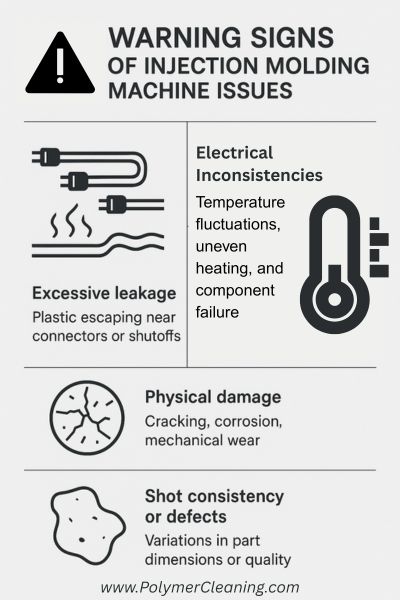
Common issues that signal it’s time to send in your system:
- Mechanical wear on plates or nozzles
- Plastic leakage around nozzle shutoffs
- Electrical inconsistencies in heaters or thermocouples
- Shot consistency issues: flashing, short shots, sink marks
These issues compound quickly and can result in catastrophic damage if ignored.
Real-World Case: 32-Cavity Manner VG Hot Runner Inspection for MGS Ireland
When MGS Manufacturing’s Ireland facility reached out, they were already noticing system-wide symptoms. Once their equipment arrived at our facility, we were able to confirm:
- Significant leakage and gassing in the control box
- Full encapsulation of pin connectors due to melted plastic
- Severe erosion and mechanical damage in the nozzle shutoff areas
- Leakage from the nozzle shutoffs themselves
- An air plate that, fortunately, just needed a quick touch up.
Step 1. Shipping Your Components to PCT
The repair process starts the moment your shipment arrives, but how you package and prepare your system can make a big difference in speed and safety.
Tips to prepare your shipment:
Label wires, connectors, or parts that are easily confused
Wrap electrical and sensitive components to avoid shipping damage
Provide a brief note detailing symptoms, operating conditions, and any recent changes to performance
For reference, MGS’ shipment included:
- The fully assembled hot half
- The valve pin system
- The electrical control box
- The air plate assembly
Step 2. Inspection & Disassembly
Once your system arrives at PCT’s facility, the documentation begins immediately. Each job is assigned a PCT Job Number, and components are cataloged and visually inspected before full disassembly.
We follow a multi-point teardown and diagnostic process, which includes:
- Logging parts received
- Full disassembly of mechanical and electrical systems
- Detailed inspection for carbonization, plastic flow paths, erosion, and mechanical wear
- Resistance and continuity tests for all heaters and thermocouples
- Gauging of shutoff diameters, valve pin wear, and bushing integrity
MGS’ 32-cavity Manner VG Inspection Findings:

- Control box showed heavy contamination and off-gassing
- Pin connectors were completely encapsulated – a telltale sign of severe plastic leakage
- Valve pins and shutoff guides were gauged and found within tolerance
- Nozzle shutoffs exhibited heavy mechanical damage and erosion
Step 3. Hot Runner System Diagnostic Report & Recommendations
Following disassembly and inspection, we compile a detailed Hot Runner Diagnostic Report that outlines everything you need to know to approve or decline the repair.
Report Highlights for MGS (Job #28690):

The report includes:
✔ Items that are in tolerance and reusable
❗ Items that require replacement or rework
💡 Additional notes or warnings (e.g., possible damage on mold-side components)
Each section is clearly marked and supported with visual references when possible. All pricing and timelines are provided before any work begins. This clarity ensures there are no surprises, no unauthorized charges, and no blind approvals.
Step 4. Hot Half Repair Process
After receiving approval, we move into the repair and reassembly stage. Each action follows a strict quality protocol. Standard Services May Include:
- Welding and resurfacing eroded shutoffs
- Replacing and rerouting electrical systems
- Installing new connectors, heaters, and thermocouples
- Rebuilding pistons, pins, and actuator seals
- Alignment of all components before reassembly
For MGS, this included:


- Jig-ground shutoffs to exact tolerances
- Full rewiring and control box reassembly
- New pin connectors and electrical shielding
- Manifold and air plate reinstallation
- Structural fasteners replaced and torqued to spec
Each subassembly was checked before moving to the next phase, ensuring accuracy at every step.
Step 5. Final Testing & Quality Verification
Once rebuilt, every system is bench-tested to ensure accurate performance and safety:
- Heaters and thermocouples tested for continuity and resistance
- Pistons tested for proper stroke and seal retention
- Full system run-up using a bench control panel (when applicable)
- Visual and thermal inspection of wiring paths and connectors
- Final torque and fastener check
✔ MGS Manufacturing’s repaired hot half passed all QA checks and was certified production-ready.


Step 6. Return Shipping & Ongoing Support
Your repaired hot half / hot runner system is secured using high-density foam and antistatic materials. We also include:
- A copy of the repair report
- A maintenance sheet for operators
- Optional follow-up support from our service team
Our goal is to make sure the moment your system lands on your floor, it’s ready to plug in and run.
Polymer Cleaning Technology: Leading the Way in Hot Runner Services and Parts
With a reputation for precision and reliability, PCT helps manufacturers keep their hot runner systems operating at peak performance.
Services Offered
Hot Runner Cleaning
Specialized chemical-free cleaning systems remove polymer residue without damaging metal surfaces.
Hot Runner Maintenance
Thorough Inspection, Testing, Analysis, Assembly, and Comprehensive Reports.
Preventive Maintenance Programs
Tailored service schedules to suit production environments.
Component Repair & Refurbishment
Includes manifolds, heaters, nozzles, and temperature control systems.
Reverse Engineering & Custom Parts
Solutions for hard-to-find or discontinued OEM parts.
Parts Inventory
- Nozzle Tip Insulators
- Heaters (coils, bands, cartridges)
- Thermocouples
- Nozzle Tips
- Valve Pins
- Nozzle Housings
- Valve Bushings
- Pistons & Spacers
- Seal kits (O-Rings)
Final Thoughts: From Breakdown to Back Online
(Injection molding) Manufacturing Machine repairs aren’t just about fixing what’s broken – they’re about restoring trust, optimizing production, minimizing downtime, and extending machine life. At Polymer Cleaning Technology, we combine expert craftsmanship with documented, transparent service.
This repair of MGS’ 32-cavity hot runner system is just one of many examples showcasing the value we bring to manufacturers in over 60 countries around the world.
*This information is to be used as a general guideline only. Speak to your system manufacturer directly for verified information regarding your Hot Runner System.

Find this information useful? Share with friends & colleagues:
Contact Information:
Polymer Cleaning Technology, Inc.
sales@polymercleaning.com
+1 (908) 281-0055
